As an Annual Sponsor of GLC-AAAE, organizations have the exclusive opportunity to showcase their current projects on our website as the Featured Spotlight of the Month.
For the Month of October, our Featured Annual Sponsor of the Month is Crawford, Murphy & Tilly!
Company Profile
Crawford, Murphy & Tilly is an infrastructure professional services firm working with clients and their communities to shape the future, together. The firm’s mission is to provide superior infrastructure solutions, responsive to clients’ needs and expectations, while fostering growth and development for employees.
CMT delivers value-driven solutions and exceptional experiences across airports, military airfields, and public infrastructure nationwide. Our team provides integrated expertise in planning, engineering, architectural design, environmental services, and construction management, ensuring seamless execution from concept to completion. Rooted in a culture of strong project management and client partnership, we deliver tailored, innovative, and sustainable infrastructure solutions that address real-world challenges and enhance quality of life. We prioritize responsive service, technical excellence, and the professional growth of our people, ensuring every project delivers long-term impact.
For more information on how CMT is driving positive change through civil infrastructure, please visit cmtengr.com and connect with the firm on LinkedIn, Facebook, Instagram, and X.
Airport
St. Louis Lambert International Airport
Project Name
New West Deicing Pad
Project Description
St. Louis Lambert International Airport (STL) serves as the primary commercial airport for the St. Louis metropolitan region and is one of the Midwest’s key transportation gateways. Located approximately 14 miles northwest of downtown St. Louis, the airport provides domestic and international air service, connecting millions of passengers annually to destinations across the United States and beyond. STL plays a vital role in supporting regional economic growth, business travel, tourism, and air cargo operations while continuing to invest in facility improvements and modernization initiatives to enhance the passenger experience.
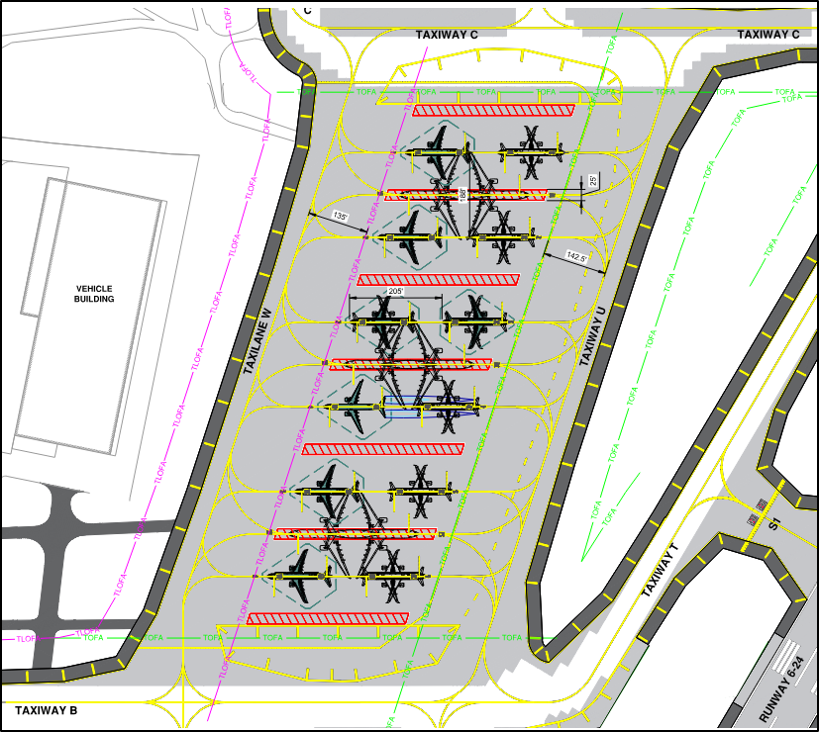
CMT is lead designer for a new centralized deicing facility at St. Louis Lambert International Airport. The need for a dedicated deicing pad was identified in the Airport’s latest Master Plan to accommodate STL’s long-term needs, particularly with the implementation of a new consolidated terminal ahead. The deicing pad will improve the airport’s operational efficiency during deicing events and optimize collection of spent aircraft deicing fluid (SADF).
The centralized De-Icing Pad will include twelve parking positions including six active deicing spots, with three positions for wide-body aircraft deicing. The facility will include a consolidated glycol storage area, fill stations, ground support equipment parking, and crew shelter. The apron includes overhead area lighting, in-pavement centerline lighting, and dedicated vehicle staging locations. The SADF will be collected and separated from the storm water runoff then pumped to a new force main that will connect to the airport’s existing SADF collection system.
The project location is in an area that has previously had flooding concerns. To mitigate this, a new basin will be constructed. Additionally, a storm water diversion structure will be implemented in a nearby tributary that will redirect some of the flow through existing culverts to an existing oversized basin farther from the project site. These storm water improvements are not only important for the new deicing pad; they will help improve the overall storm water management of the airfield.
The new deicing pad will begin construction in 2028, simultaneously with the reconstruction of the southern portion of Runway 6-24.
|